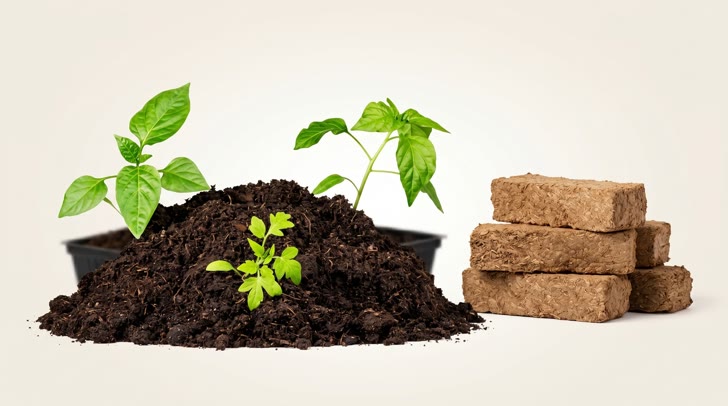
Baltic Peat
High-moss sphagnum peat from Baltic raised bogs — the reference substrate for professional horticulture.
Baltic Peat is a low-decomposition, high-moss sphagnum peat sourced from Baltic peatlands. It is the gold-standard base for potting mixes, seedling substrates, greenhouse production, and custom fertiliser blends. We supply it in bulk 40-ft sea-container loads to growers and substrate manufacturers across the GCC.
- 98.5% organic matter
- 95% volume porosity
- H2 / low decomposition
- Low salt content
- Heavy metals below limits
Overview
What makes Baltic sphagnum the professional benchmark
Baltic peat's physical, biological, and chemical properties are shaped by the climate and geology of these northern latitudes — strong moisture absorbability, open air circulation around the roots, and low heat conductivity combine to create near-ideal conditions for root-system development.
The raised bogs here produce an exceptionally pure, low-decomposition peat. Its very high organic matter content, minimal ash, and balanced air–water ratio make it the reference growing medium in professional horticulture worldwide — from Dutch glasshouses to GCC nurseries.
- Very high organic content, minimal mineral contamination
- Low ash confirms high purity
- Volume porosity of 95% keeps root systems oxygenated
Technical
General Technical Characteristics
| Parameter | Unit | Result |
|---|---|---|
| Peat type | — | High-moss sphagnum peat |
| Decomposition (Von Post) | H | H2 |
| Decomposition rate | % | 10 – 15 |
| Organic matter | % | 98.49 |
| Ash content | % | 1.51 |
| Moisture content | % | 45.50 |
| Bulk density (air-dry mass) | kg/m³ | 184 |
| Bulk density (dry matter) | kg/m³ | 100 |
| Volume porosity | % | 95 |
Physical
Physical Properties
Exceptional water retention combined with a balanced air–water ratio — the reason Baltic peat remains the default base for sensitive crops.
| Property | Unit | Result |
|---|---|---|
| Water capacity (dry matter) | % | 820 |
| Water capacity by volume | % | 82 |
| Air capacity | % | 13 |
Chemical
Chemical Properties
Naturally acidic with very low soluble salts — an ideal blank canvas for fertiliser and lime adjustment.
| Parameter | Unit | Result |
|---|---|---|
| pH (KCl) | pH | 2.72 |
| pH (H₂O) | pH | 4.05 |
| Electrical conductivity | mS/cm | 0.020 |
Micronutrients
Microelement Content
| Element | Content (mg / kg DM) |
|---|---|
| Mn | 68.2 |
| Cu | 6.1 |
| Zn | 9.5 |
Safety
Heavy Metal Content
Heavy metal levels sit well within safe horticultural limits — a direct reflection of the environmental purity of Baltic peat deposits.
| Element | Content (mg / kg DM) |
|---|---|
| Cd | < 0.05 |
| Pb | 5.9 |
| Hg | < 0.01 |
| As | < 0.01 |
| Cr | 1.0 |
| Ni | 1.7 |
Nutrients
Available Nutrient Forms
Extracted with 0.2 N HCl at a 1 : 50 ratio. Values are moderate — the substrate needs fertilisation when used as a growing medium.
| Nutrient | Value (mg / 100 g DM) |
|---|---|
| NH₄-N | 16.8 |
| NO₃-N | 0.0 |
| P₂O₅ | 12.1 |
| K₂O | 13.9 |
| CaO | 417.6 |
| MgO | 68.3 |
| Fe₂O₃ | 59.4 |
Botany
Floristic Composition
The peat is formed primarily from Sphagnum moss species typical for Baltic raised bogs:
- Sphagnum magellanicum — 50%
- Sphagnum angustifolium — 10%
- Sphagnum fuscum — 10%
- Sphagnum spp. — 5%
- Eriophorum vaginatum — 15%
- Scheuchzeria palustris — 10%
Botanical classification: high-moss sphagnum peat.
Applications
Typical Applications
Seed germination
Ideal fine structure for precision sowing.
Vegetable seedlings
High water retention with open aeration.
Flower production
Low EC keeps nutrient programmes under tight control.
Greenhouse substrates
A benchmark base for custom mixes.
Soil conditioning
Rebuilds structure in degraded soils.
Substrate manufacturing
Commercial potting-mix and hydroponic blends.
Fractions
Available Fraction Sizes
Three fractions are produced — each tuned to a different stage of the growing cycle.
0 – 10 mm · Fine
Very high water retention — used as sowing soil (often for automatic sowing lines) and for propagation of seed vegetables, trees, and decorative plants.
0 – 20 mm · Standard
The most versatile grade — balanced substrate mixes suited to a broad range of plants. Optimal water circulation with good drainage.
0 – 40 mm · Coarse
Higher air capacity — intended for perennial potted plants where root systems benefit from stronger aeration.
Next step
Need a technical datasheet with your lot number?
Tell us your destination port and your target volume — we'll send a full certificate of analysis along with a CFR / CIF offer.
Frequently asked
Buyer Questions
What grades and particle sizes do you supply?
Standard is fine 0–10 mm for substrate manufacturing and vegetable seedlings. Coarser grades (10–25 mm) are available for flower production and bulk substrate blending. Both come with full GOST analysis sheets.
What is the minimum order?
1,000 MT per programme (approximately 50 × 40-ft sea containers). Trial parcels of 250 MT can be arranged for first-time buyers.
What is the moisture content on shipment?
50–60% moisture by weight, packed in plastic-wrapped bales for moisture control during sea transit. Full moisture profile is on the Certificate of Analysis.
Can you supply private-label packed goods?
Yes — packaging in 250L plastic bales, big-bags, or 1,000L IBCs, each with optional private-label printing. Container counts adjust for the packed-goods density.
What origins do you ship from?
European Baltic peatlands. Specific extraction sites are nominated per shipment; full Certificate of Origin is issued.
Which Incoterms are available?
FOB (Baltic ports), CFR, and CIF GCC. Direct CIF to Jebel Ali, Hamad (Doha), Sohar, and Dammam are most common.
Explore
Related Products
Chemical Fertilisers
Nitrogen, phosphorus, potassium, and NPK blends from vetted producers — in the specs your agronomy demands.
Wheat
Grade 3 milling wheat at world-class spec — bulk supply via the Aktau/Caspian corridor, with alternative origins on request.
Urea 46
46% nitrogen urea at world-class spec — prilled and granular grades, multi-origin supply via Caspian, Black Sea, and Persian Gulf corridors.
Organic Peat Suspension
A natural soil activator based on peat-derived humic and fulvic substances — liquid, concentrated, fertigation-ready.
High-Moor Peat
Working-grade sphagnum peat from CIS raised bogs — GOST-certified, rich in humic acids, built for substrate and compost programmes.